You’re Not Bad At Design. You’re Invisible.
The First Client Blueprint — a practical system for self-taught designers who can already do the work, and just need someone to explain how the client part actually works.
It’s 12:47am. You just posted your newest mockup to your WhatsApp status.
You check it every ten minutes after that. Views go up. Replies don’t.
Two “nice one” comments. From other designers. Not one message asking your rate.
Maybe I’m still not good enough.
You open a tutorial anyway. Not because you need it — because it feels like doing something.
Here’s the part that took me a year to understand: that thought is wrong. And it’s costing you clients right now.
You didn’t skip the work. That’s exactly why this is so frustrating.
You put in real hours. Figma tutorials, Canva templates, maybe a course. You have pieces you’re proud of.
And still, nothing moves:
Your posts collect likes from other designers. Not inquiries from clients.
You joined Fiverr or Upwork. Your profile sits between ten thousand others that look just like it.
Friends occasionally “hook you up.” It works once. Then it goes quiet again.
The freelance advice you find is American. Different tools. Different clients. Doesn’t translate.
More than once, you dropped your price just to get something. It only made you doubt your work more.
None of that means you’re not good enough. It means something else is broken. Keep reading.
You’re not an underskilled designer. You’re an Invisible Designer.
An Invisible Designer isn’t bad at design. They’re just doing the one thing that guarantees no one finds them: posting quietly and waiting.
Clients don’t browse WhatsApp statuses hoping to discover a designer. They get recommended one. Or they get messaged by one directly.
So the fix was never “get better at Figma.” It was becoming visible on purpose. Here’s how.
I was an Invisible Designer for close to a year.

I’m a university student in Lagos. Everything I know about design, I taught myself — late nights, free tutorials, a lot of trial and error.
For months my routine looked the same. Learn something new. Post it. Refresh my notifications. Nothing.
Each time, I did the same thing: assumed I needed to learn more. Another tool. Another style. Another certificate.
My skills kept improving. My client count stayed exactly where it started — at zero.
The frustrating part wasn’t the silence. It was not knowing why I was being ignored, when the work itself wasn’t the problem.
What actually changed things had nothing to do with design software. Here’s what it was.
A portfolio is proof. It was never supposed to be the pitch.
I kept treating my portfolio like a shop window — put the work up, wait for someone to walk past.
But a portfolio is something you show after a conversation has already started. Not something that starts it.
Once I understood that, the question changed. It stopped being “am I good enough.” It became “who do I message, and what do I actually say.”
That question has a specific answer. It’s the free framework below — and then it’s the entire guide.
The 3 gaps that keep every Invisible Designer stuck
You can use this without buying anything. It’s the exact lens that changed how I saw the problem.
Can you make something worth paying for? If you’ve learned for 6–12 months, this is likely already closed. Most beginners overestimate how much more they need.
Does the right person know you exist? Posting and waiting closes almost none of this. Direct outreach closes almost all of it.
Why would a stranger pay a stranger? This closes through how you approach them, what you show them, and how you price your first projects.
Most self-taught designers are stuck at gap 2. They keep working on gap 1, which is already closed.
Closing gaps 2 and 3 is the entire guide. Here’s exactly what’s in it.
Once I stopped being invisible, people kept asking me to explain what I actually did. Typing it out one DM at a time got exhausting. So I wrote it down once, properly.
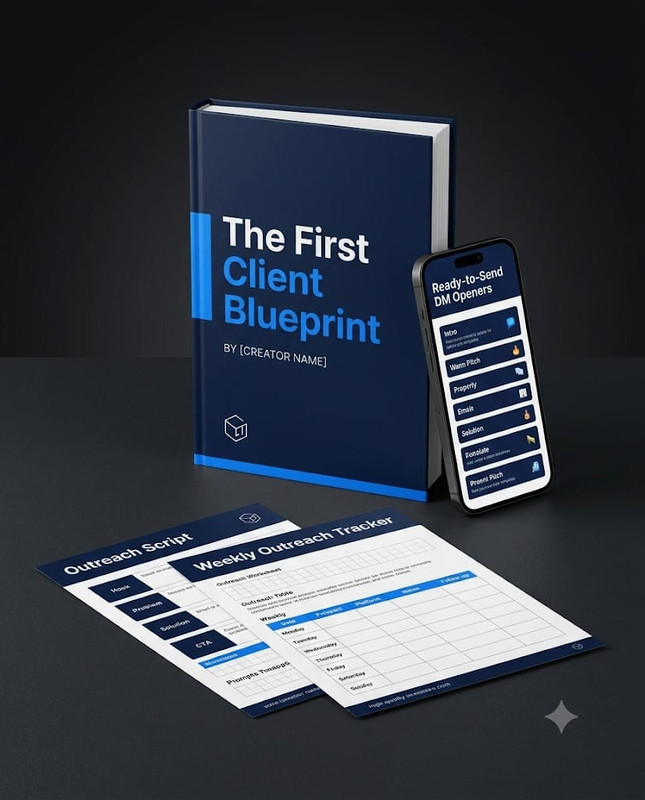
Not a list of chapters. A path out of being invisible.
Why not just watch YouTube for free?
Most of it is American — different tools, different client behaviour, different payment norms. This is written for outreach here, not adapted from there.
Those platforms put you in a sea of ten thousand identical profiles. This guide is about getting found directly, without competing on a race-to-the-bottom listing page.
Most courses teach freelancing in general. This solves one specific problem — going from zero clients to your first one — and stops there.
Who this is for
Who this is NOT for
Proof over promises — see it before you trust it.
This guide is new, so I’m not going to fabricate reviews to make it look established. Here’s what you can actually check before buying:
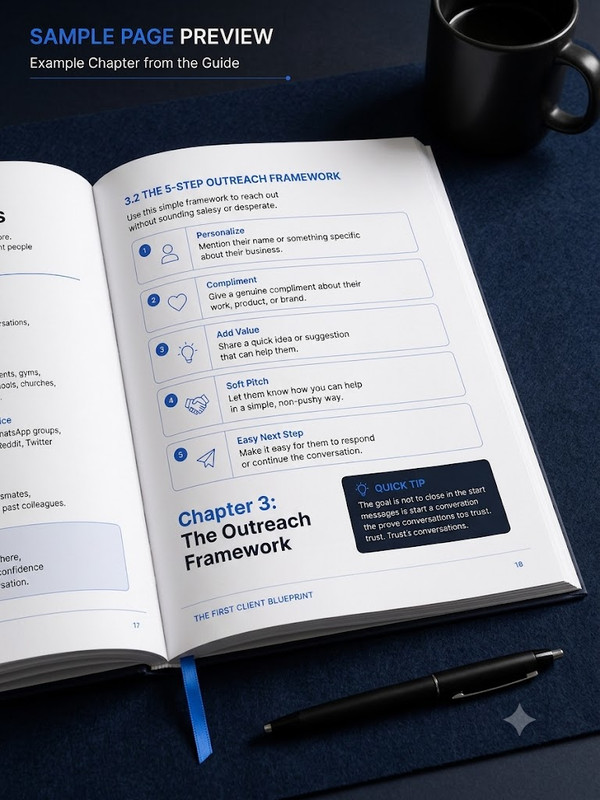
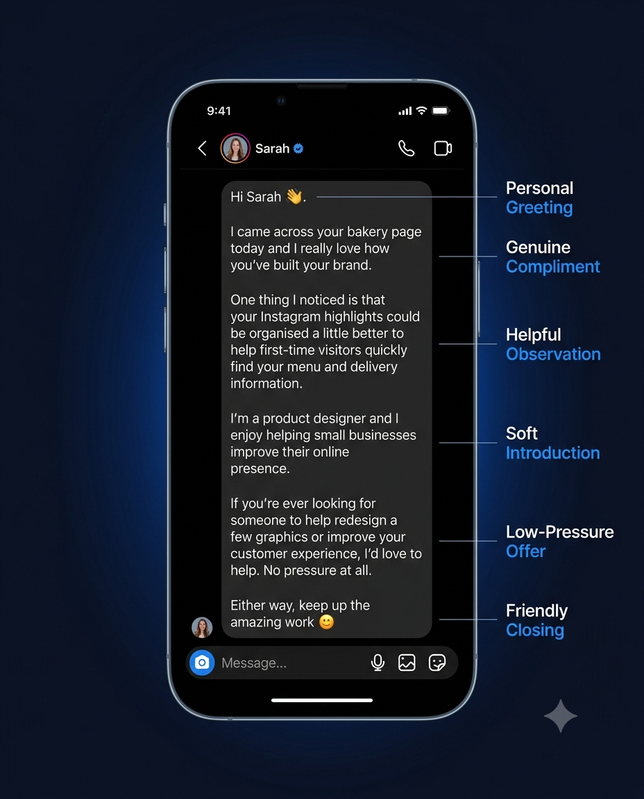
Instead of reviews, you get direct access to me if you get stuck implementing anything — a real person, replying, not a testimonial page.
Included with your purchase
A one-page swipe file beyond the 3 core scripts — extra cold openers, extra warm openers, and one for reconnecting with a past contact.
Price
This is a genuine launch price. It goes back up once the launch period ends.
Instant download after payment
What happens if you get stuck
This is a digital product delivered instantly, so there are no refunds once it’s downloaded.
Here’s what you get instead: if you go through the guide and get stuck applying anything in it, you can reach me directly on WhatsApp. Not a support ticket queue — an actual reply from the person who wrote it.
Questions people usually ask
Free content exists, but it’s scattered and mostly built for a different market. This is one focused system for one specific problem, written for how things work here — meant to save you the months I spent piecing it together myself.
If you’ve been learning 6–12 months and have work you’re comfortable showing, this was written for you. It doesn’t teach design software — it teaches what to do once you already have skill and nobody’s responding.
It’s written from a Lagos perspective, but the system — who to target, how to reach out, how to price early projects — works just as well if you’re a Nigerian creative based in the UK, US, or Canada.
Message me on WhatsApp and tell me what you tried. I’ll help you troubleshoot it directly instead of leaving you to figure it out alone.
A digital PDF. After payment, you get an instant download link. No waiting, no shipping.
Honestly — you don’t have to take my word alone. Check the sample pages above before you buy. I’d rather you see it than just trust me.
You already closed the skill gap.
What’s been missing is knowing who to message, what to say, and what to charge. That’s the entire blueprint — written by someone who was invisible a year ago too.
Stop Being Invisible — Get The Blueprint₦7,500 · Instant download · Includes the DM openers bonus